
Most people know the feeling: a conversation is moving along, nothing seems unusual at first, and then something changes in a way that is easy to miss. The room still feels normal. The words are ordinary. No one stops. But a sentence lands differently, a concern appears, or a thought comes forward before there is time to dress it up. For a second, the person notices it, and then the moment moves on.
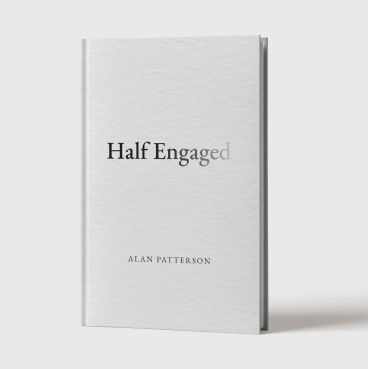
Alan Patterson’s Half Engaged begins in that space. The book does not chase dramatic turning points or grand declarations. It pays attention to the smaller moments that usually disappear before anyone names them. These are the moments before someone speaks clearly, asks the better question, or admits that something does not feel right. Patterson is interested in the instant when awareness appears, and more importantly, what people do with it once it arrives.
That is what gives Half Engaged its quiet force. The book is not written as a manual, and it does not tell readers to become louder, tougher, or more forceful in every room they enter. Its message is more subtle than that. It asks readers to notice when they are physically present but not fully available to the moment in front of them.
To be half engaged, as the book suggests, is not to be absent. It is more complicated. A person can be in the conversation, following the discussion, nodding at the right time, and still holding something back. They may sense the opening for honesty and let it close. They may recognize that something is off and decide not to interrupt the flow. They may know what needs to be said, then convince themselves it can wait. Sometimes it can. Sometimes waiting is wisdom. But sometimes it is hesitation wearing better clothes.
Patterson writes with a sharp awareness of that difference. Throughout the book, he returns to the ways people explain away their own restraint. They call it timing. They call it patience. They call it being strategic. In some situations, those words may be true. In others, they become a way to avoid the discomfort of entering the moment fully. This is one of the strongest ideas in Half Engaged: people often know before they admit that they know.
They feel the shift in a conversation before they can explain it. They sense when a project is drifting. They understand, somewhere inside, that the clearer thing needs to be said. Yet the moment is easy to miss because it rarely arrives with drama. It comes quietly. It can be dismissed as a passing thought or buried under the pace of the day. The book asks readers to slow down enough to see it.
Patterson brings this idea into focus through personal reflection and professional experience. In one section, he recalls an early consulting assignment where his job was to interpret feedback for managers. He had developed a method that seemed balanced on the surface: soften the difficult point by surrounding it with positives. At the time, he told himself he was being thoughtful. Looking back, he sees something else. He was avoiding clarity.
The lesson is not that kindness has no place in difficult conversations. Patterson is too careful a writer for that kind of simple conclusion. The point is that kindness without clarity can become another form of avoidance. People may leave the conversation feeling protected, but not helped. The harder truth remains untouched.
That insight gives the book practical weight. Anyone who has worked with clients, led a meeting, managed a team, or tried to say something difficult will recognize the tension. There is often a moment right before speaking when the honest sentence is available. It is simple. It is direct. Then the mind gets busy. What if this comes out wrong? What if the other person reacts badly? What if there is a better time? By the time all of that thinking is finished, the moment may already be gone.
Patterson does not treat this as a communication problem in the usual sense. It is not only about word choice, polish, or presentation. It is about presence. The question is whether a person remains available to what they have already noticed.
Another section of Half Engaged explores what happens when awareness is ignored in a professional setting. Patterson describes a project that showed warning signs early. Something was off. The team felt it, but kept moving. That movement looked like progress. There were slides to build, content to prepare, and a client expectation to meet. Stopping would have been uncomfortable, so they did not stop.
The result was not simply a failed delivery. The real failure happened earlier, in the unspoken moment when someone could have paused the process. That is where the book becomes especially useful for readers in business or leadership roles. Patterson shows how silence can become part of the work itself. A group can keep producing, planning, and presenting while avoiding the very thing that needs attention.
In many workplaces, that pattern is familiar. A team knows a plan is weak but continues refining it. A meeting moves past the one question that mattered. Someone sees the problem but assumes another person will raise it. The group leaves with tasks assigned and calendars updated, yet the real issue remains untouched. Half Engaged does not turn this into a lecture. It simply holds the moment up long enough for the reader to recognize it.
That recognition is central to the book’s effect. Patterson’s writing is concise, but it is not thin. He leaves room for the reader’s own memory to enter the page. A person reading the book may find themselves thinking of a meeting where they stayed quiet, a conversation that could have gone deeper, or a decision that felt wrong long before the outcome proved it. The book works because it does not need to explain every example. It trusts the reader to know.
Still, Half Engaged is not only about missed warnings. It is also about connection. Some of the most meaningful parts of the book explore what happens when a conversation moves beyond the surface. It may begin with ordinary talk, then someone says something they did not plan to say. The sentence lingers. The other person has a choice. They can move past it, or they can stay.
Patterson understands how fragile those moments are. Meaningful connection often begins before anyone realizes it is happening. There is no announcement and no formal shift in tone. One person simply chooses not to rush away from what has appeared. That choice can change the conversation. It may lead to honesty. It may create trust. It may allow someone to feel heard in a way they did not expect. The moment does not have to be dramatic to matter. In fact, the book suggests that many of the most important exchanges begin quietly, almost accidentally, because someone stayed present a little longer than comfort required.
This is where Half Engaged moves beyond the professional world. Its ideas apply to relationships, friendships, family conversations, creative work, and private decision-making. The setting changes, but the pattern remains. People notice something, and then they decide whether to enter it. Sometimes that decision is so quick they barely recognize it as a decision at all.
Patterson also explores conviction, though not in the loud, motivational sense. In this book, conviction is not about performing certainty. It is not about dominating the room or making every thought known. It is quieter. It begins when a person stops backing away from what they know to be true.
That distinction matters. Many books about communication push the reader toward confidence as an outward behavior: speak up, take charge, own the room. Patterson’s approach is different. He is less interested in performance than alignment. Are you saying what you mean? Are you responding to what you noticed? Are you present enough to stop disappearing from the conversation? Those questions give the book its emotional depth.
In one of the more personal sections, Patterson reflects on the end of a long-running professional practice after the loss of a major client. The situation could have been framed as panic or collapse. Instead, he describes something more revealing. Beneath the uncertainty, he recognized a truth that had already been there. He wanted his own practice. The important shift was not that everything suddenly became clear. It was that he stopped ignoring what had been waiting for his attention.
That is the heart of Half Engaged. The book is not asking readers to manufacture certainty. It is asking them to become more honest about the moments when they already sense something true.
This is also why the style of the book matters. Patterson’s prose is spare. The sentences often arrive in short movements, but the effect is not empty. He does not overfill the page. He lets the silence around the words do some of the work. That restraint suits the subject because the book itself is about small signals and quiet recognitions. A heavier style would weaken the effect. A more conventional self-help structure might make the ideas feel too packaged. Patterson avoids that by writing in a way that feels close to thought as it happens: brief, direct, and sometimes uncomfortable.
For readers, Half Engaged offers a different way to think about everyday life. It suggests that change does not always begin with a major decision. Sometimes it begins with the next sentence. Sometimes it begins with not dismissing a feeling too quickly. Sometimes it begins when a person refuses to call hesitation wisdom.
The book’s message is especially relevant in a time when many people are physically present but mentally divided. Meetings happen quickly. Conversations compete with distractions. People respond before they have listened fully. They move from one obligation to the next and may not notice the moments that needed more of them. Patterson’s book slows that pace and reminds readers that attention is not passive. To notice something and respond to it requires a different kind of discipline. It asks for honesty and courage, though not always the dramatic kind. Often, the courage is simply to say, “Wait. Something matters here.”
That kind of awareness can affect how a person leads. It can change how they listen. It can improve how they make decisions. More importantly, it can change how they experience themselves in the moments that matter. Because there is a cost to being half engaged. The cost may not appear immediately. The conversation continues. The meeting ends. The project moves forward. Nothing seems broken at first. But later, the moment returns. The person remembers that they felt something and let it go.
Patterson gives language to that experience. He also gives readers a way out of it, not through a formula or checklist, but through attention. The invitation of Half Engaged is simple, though not easy: notice the moment while it is happening. Notice the thought before it disappears. Notice when you are about to soften the truth beyond usefulness. Notice when movement is being mistaken for progress. Notice when a conversation has opened and deserves more than a quick escape. Once you notice, do not pretend you did not.
That is where the book leaves its strongest impression. It does not promise that every moment will be handled perfectly. It does not suggest that speaking up will always be simple. But it does make one thing difficult to ignore: people often know the moment before they act as if they do not.
Half Engaged is a reflective, timely book for readers who care about communication, meaningful work, and deeper human connection. It speaks to professionals who want to lead with more clarity. It speaks to anyone who has ever left a conversation knowing they were not fully there. It speaks to the quiet part of us that recognizes the truth before we find the words for it.
Alan Patterson has written a book about presence, but not in the abstract. He brings it down to the level where life actually happens: the sentence before the sentence, the pause before the decision, the small opening that may not come back in the same way again. The moment is usually not loud, but it is there. Half Engaged asks readers to stop missing it.
Half Engaged by Alan Patterson is now available.